Bracelets (Link & Panel)
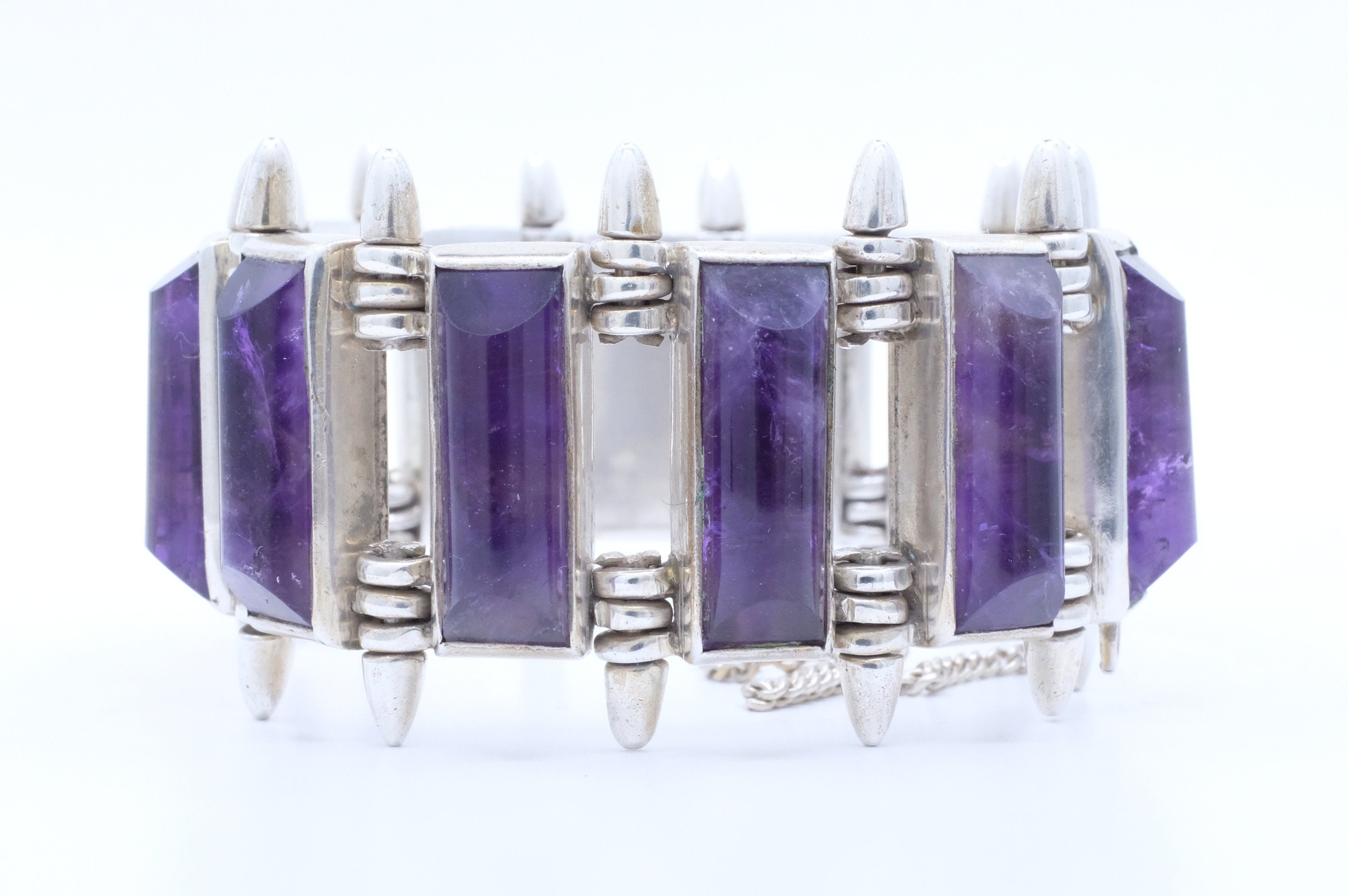
Antonio Pineda Taxco Mexico 970 Silver Amethyst Modernist Spike Bracelet
$2,500.00
-
DetailsANTONIO PINEDA AND LOS CASTILLO COOPERATIVE BRACELET
Sterling Silver and Amethyst, Taxco, Mexico, c. 1962–1963
✦
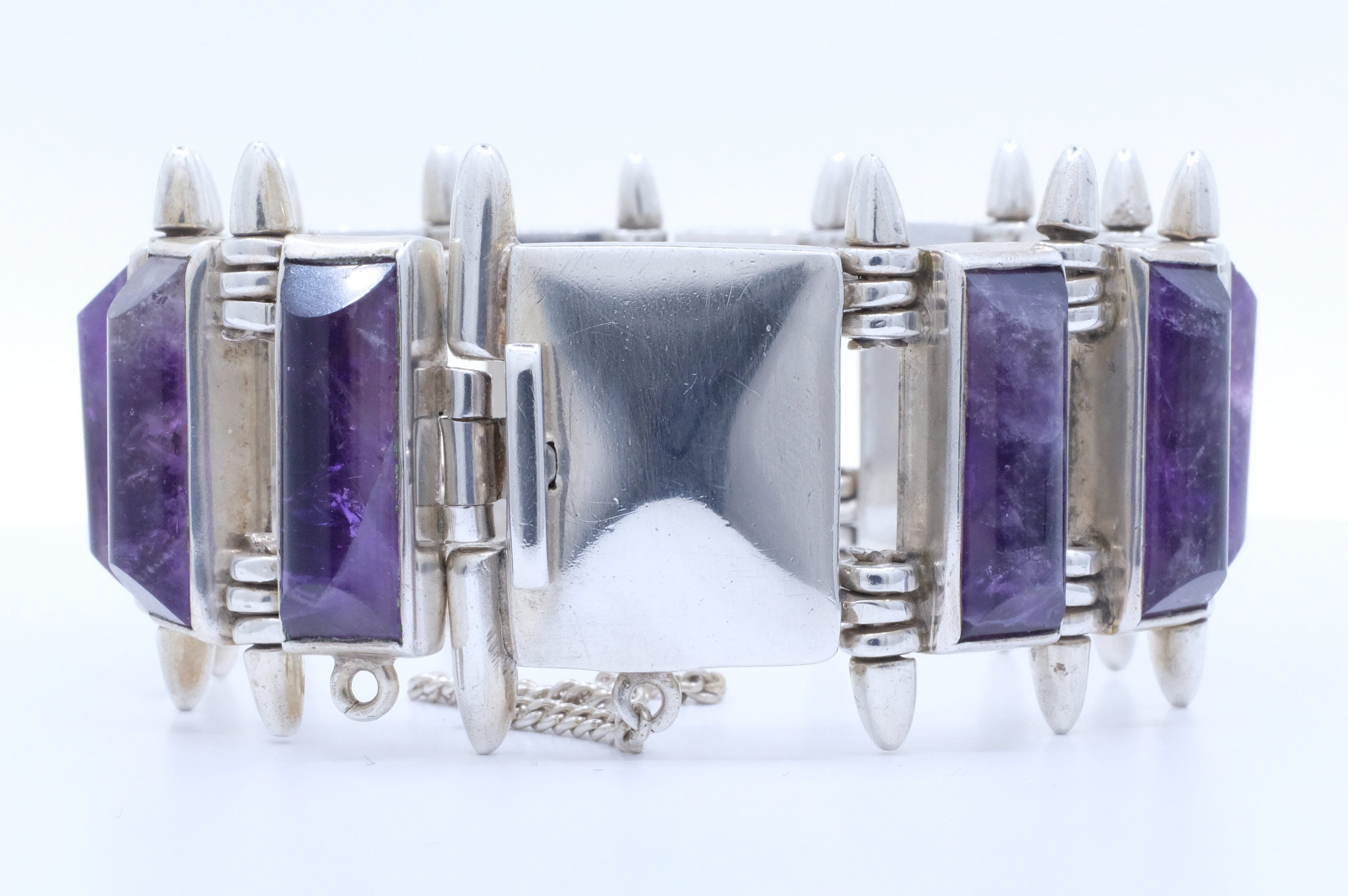
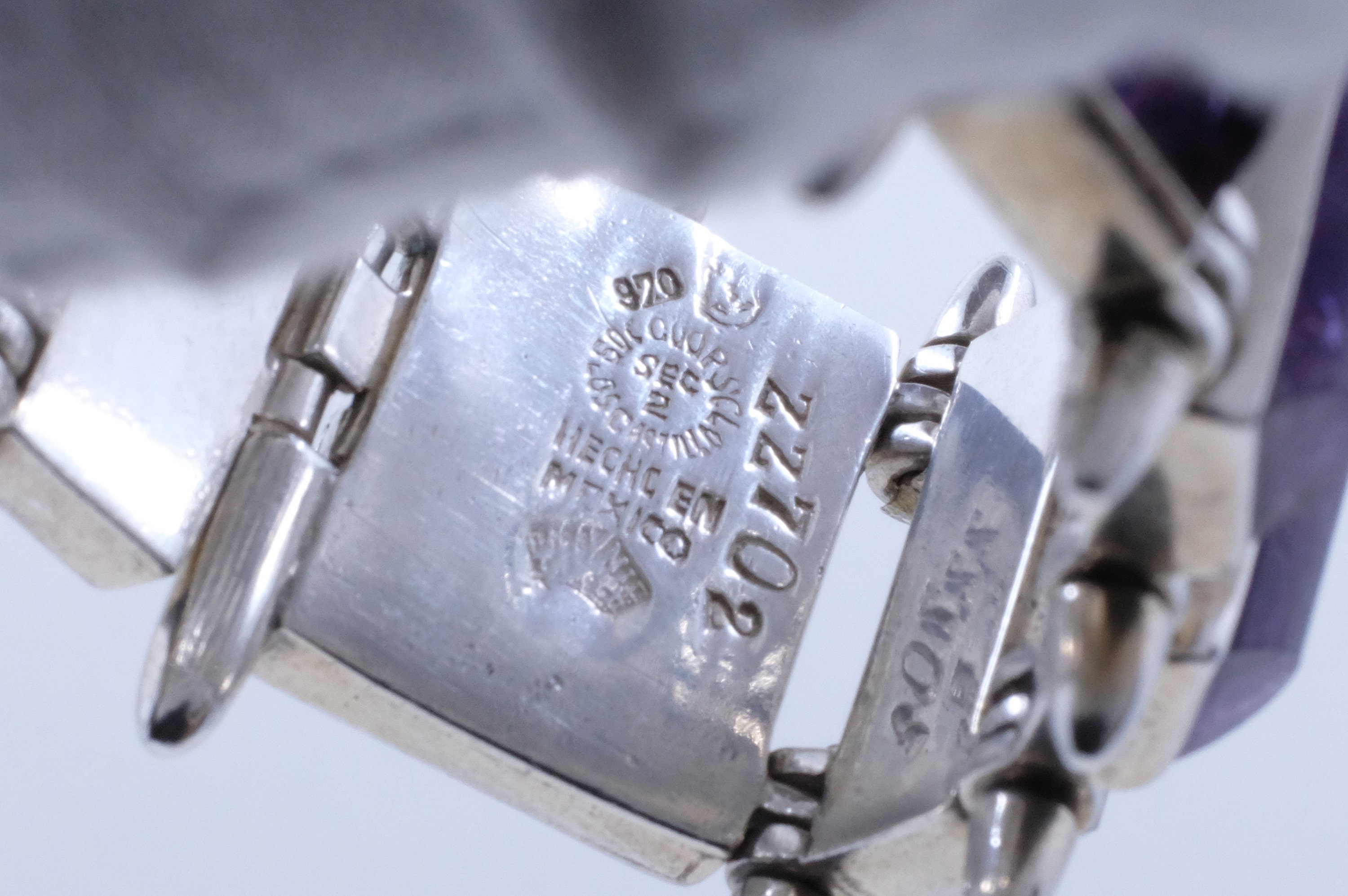
A documented co-branded piece from one of the most historically significant collaborations in the Taxco modernist canon. Sterling silver architectural link bracelet with bezel-set amethyst, hand-wrought, signed by both Antonio Pineda and Los Castillo Sociedad Cooperativa de Plateros, Sección 2. The piece bears the Antonio crown hallmark, the Los Castillo cooperative cartouche, the Mexican government eagle assay, and the Pineda inventory number ZZ 702.
✦
THE COLLABORATION
Antonio Pineda's relationship with Los Castillo predates the existence of his own workshop. After apprenticing at fourteen in William Spratling's Taller de las Delicias and training in Mexico City alongside the Art Deco silversmith Valentín Vidaurreta, Pineda spent his earliest professional years working as a silver craftsman at Los Castillo, the Taxco workshop founded in 1939 by the four Castillo brothers (Antonio, Jorge, Miguel, and Justo). Pineda left Los Castillo to open his own taller in 1941, and the two operations became independent forces in the Taxco silver renaissance through the next two decades.
The story did not end with separation. By the early 1960s, Los Castillo had reorganized as a silversmiths' cooperative, the Sociedad Cooperativa de Plateros, with internal sections each operating as a semi-autonomous workshop. In this cooperative era, Antonio Pineda's workshop and Los Castillo Sección 2 produced a body of co-branded jewelry bearing both makers' marks side by side on a single piece. These collaborations are documented in the Hodosh collection, the foundational private collection of mid-century Taxco silver that formed the core of the 2008–2009 Fowler Museum retrospective Silver Seduction: The Art of Mexican Modernist Antonio Pineda. Co-branded pieces from this period appear with the Antonio crown, the Los Castillo cooperative cartouche, the Mexican eagle assay (commonly Eagle 58 for this era), and Pineda's distinctive ZZ-prefix inventory numbers.
The co-branded pieces are uncommon. They sit at the intersection of two of the most collectible names in Mexican modernist silver, and they document a moment when Mexican silversmithing was organizing itself cooperatively while continuing to produce work of museum quality.
✦
THE DESIGNER
Antonio Pineda (1919 to 2009) is recognized in Mexico as a national treasure and internationally as one of the foremost figures of the Taxco silver renaissance. By 1944 his work had been included in an exhibition at San Francisco's California Palace of the Legion of Honor, where Richard Gump purchased the entire one hundred sixty piece collection and established the exclusive American distribution arrangement that would define Pineda's reach for the following two decades. His work entered the permanent collections of the Los Angeles County Museum of Art and the Fowler Museum at UCLA, and was the subject of the 2008 to 2009 Fowler retrospective Silver Seduction. At the workshop's peak, Pineda employed nearly one hundred silversmiths.
Pineda is particularly known for his use of amethyst, which appears throughout the major collections of his work and which he favored for its color depth and its compatibility with high-purity 970 silver.
✦
THE WORKSHOP
Los Castillo was founded in Taxco in 1939 by the four Castillo brothers. All four had apprenticed at William Spratling's Taller de las Delicias, the workshop that founded the modern Taxco school. Across its decades of production, Los Castillo trained and employed many of the silversmiths who would go on to define the Taxco renaissance, including Salvador Terán, Sigi Pineda, and Antonio Pineda himself. The workshop is known for its quality silver wares as well as for innovations in mixed metals, incorporating copper and brass with sterling silver in ways that Spratling and the broader Taxco school had not previously attempted. Antonio Castillo's first wife, Margot van Voorhies Carr, designed for Los Castillo before opening her own taller as Margot de Taxco. The Castillo family is still in the silver business today, with Antonio Castillo's daughter Emilia and granddaughter Cristina continuing the workshop tradition.
In the early 1960s the workshop was organized as the Sociedad Cooperativa de Plateros (Silversmiths' Cooperative) with multiple sections. The "Los Castillo Soc Coop Scl Sec 2" mark visible on this bracelet is the cooperative cartouche specific to that era and section.
✦
THIS BRACELET
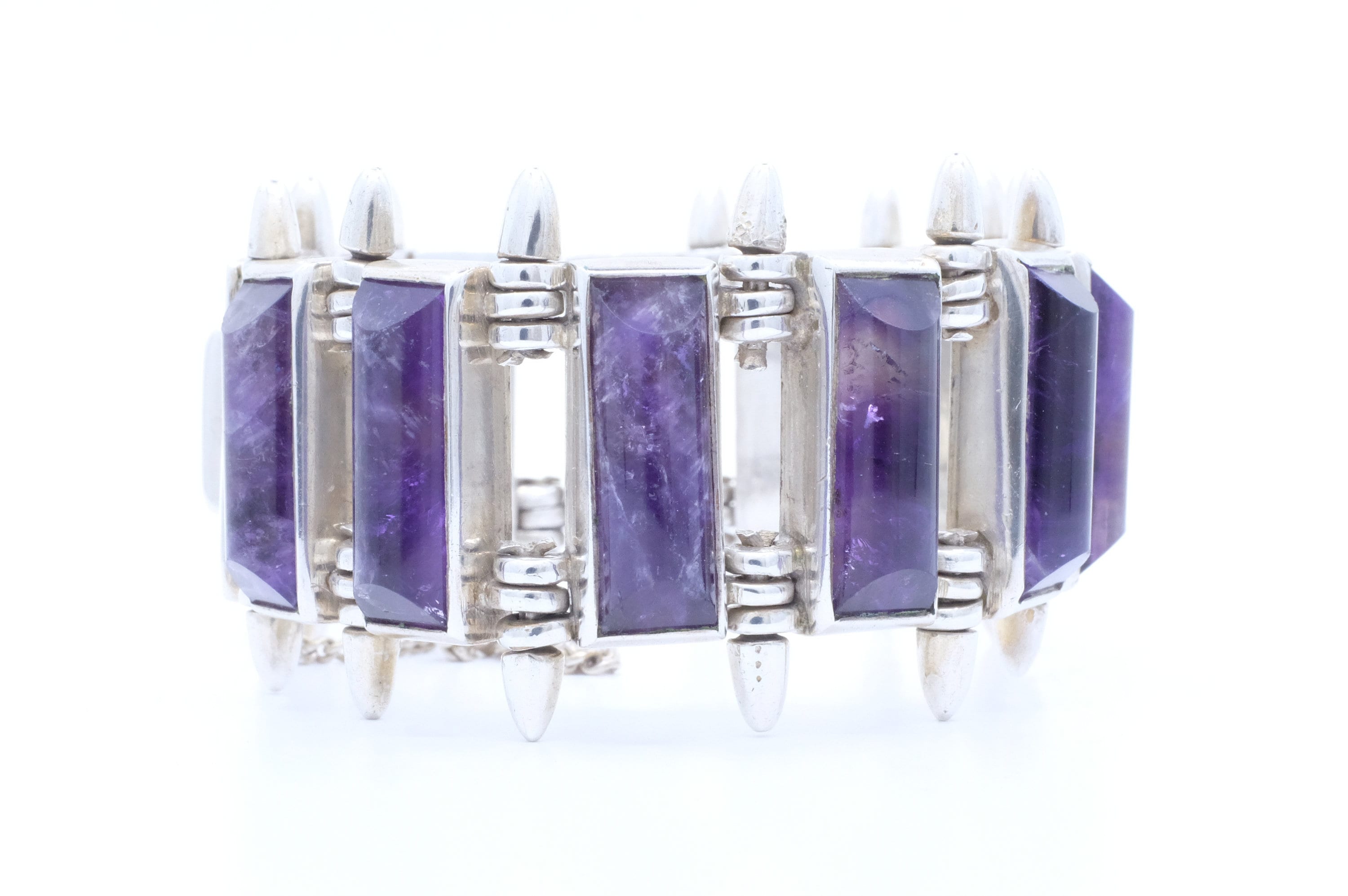
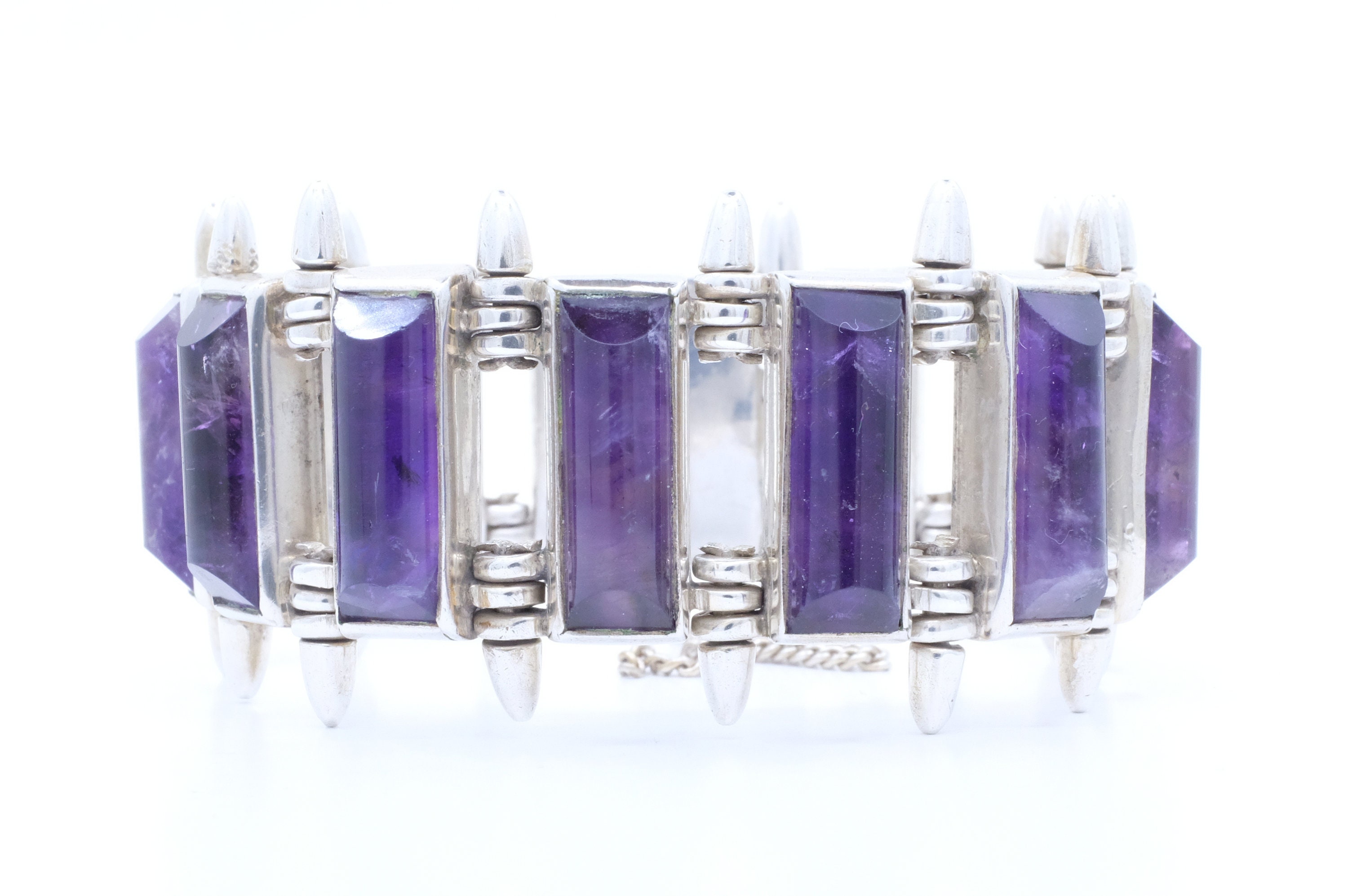
The bracelet is built from a series of articulated rectangular links in 970 silver, each set with a substantial bezel-set amethyst at the centerline. The construction is hand-wrought, with hidden hinge articulation between the links and a box clasp with safety chain. The amethysts are deeply saturated, true purple in tone, set proud of the silver surface so the stones do the color work and the metal does the structural work. This is Pineda's signature combination: high-purity silver, fine bezel work, amethyst as the color anchor.
The piece reflects both makers in its construction. The architectural rigor and inventory marking are pure Pineda. The cooperative cartouche and the assay registration are Los Castillo. Together they document a single object made within a documented institutional collaboration between the two most influential workshops of the Taxco modernist period.
✦HALLMARKS AND SPECIFICATIONS
Maker marks: Antonio Pineda crown hallmark; Los Castillo Sociedad Cooperativa de Plateros, Sección 2 circular cartouche
Silver content: 970
Origin: HECHO EN MEXICO, Taxco, Guerrero
Assay: Mexican government eagle assay (Eagle 58 typical for this era and configuration)
Inventory number: ZZ 702 (Antonio Pineda design/catalog number)
Period: c. 1962–1963
Stones: Bezel-set amethyst
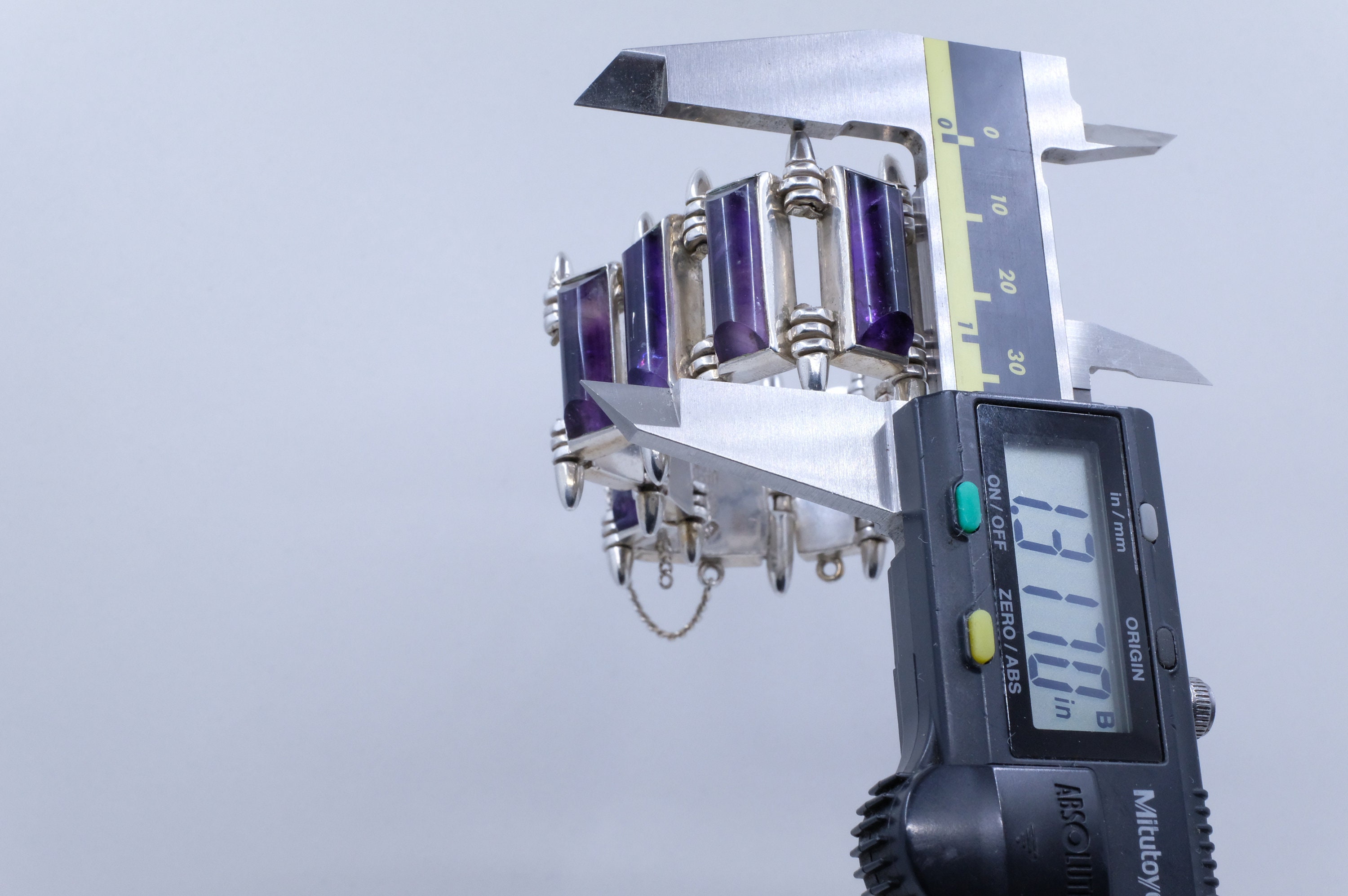
Construction: Articulated rectangular links with hidden hinge articulation, box clasp with safety chain
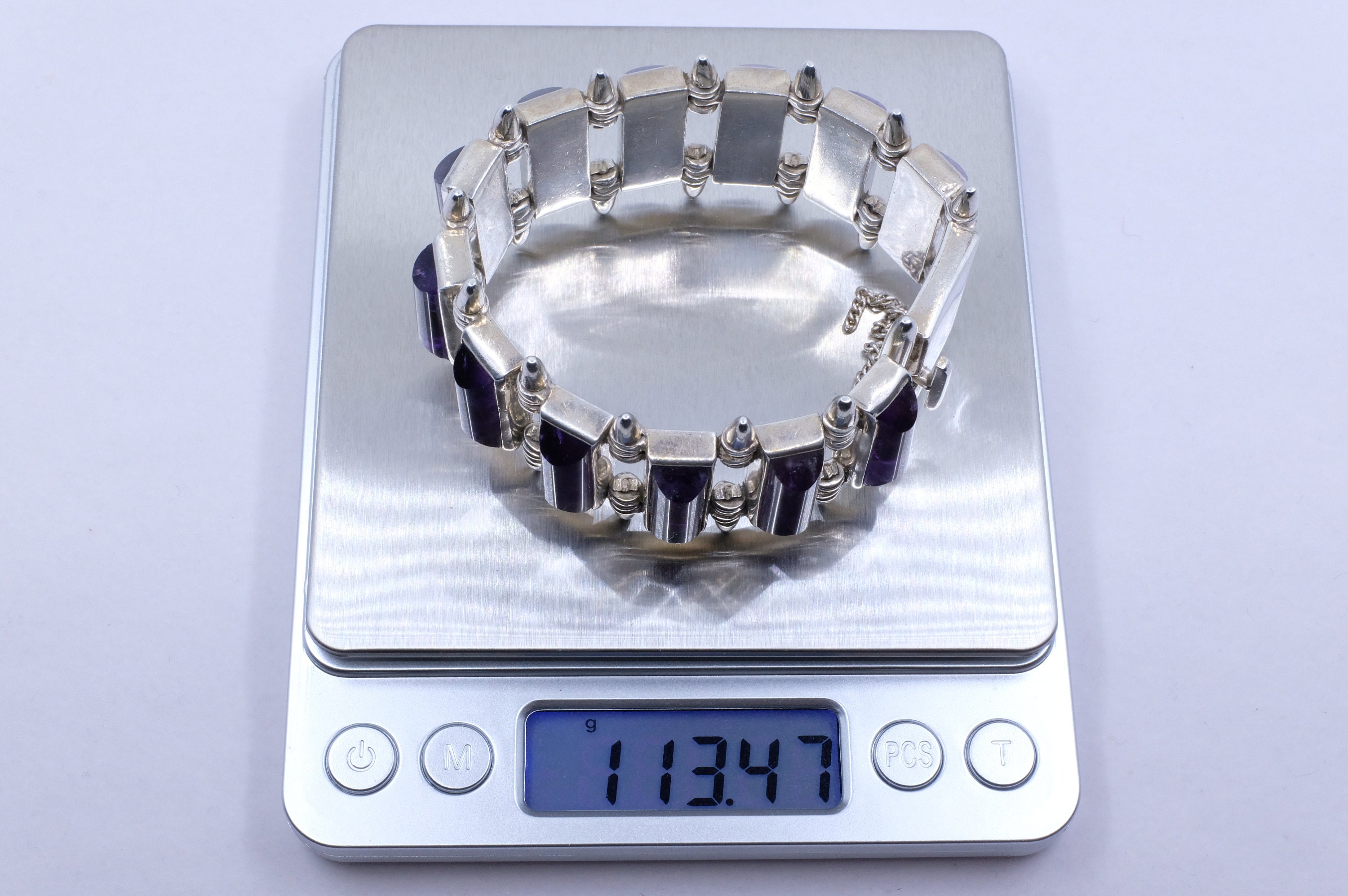
Weight: 113 grams
Length: [to confirm, end to end]
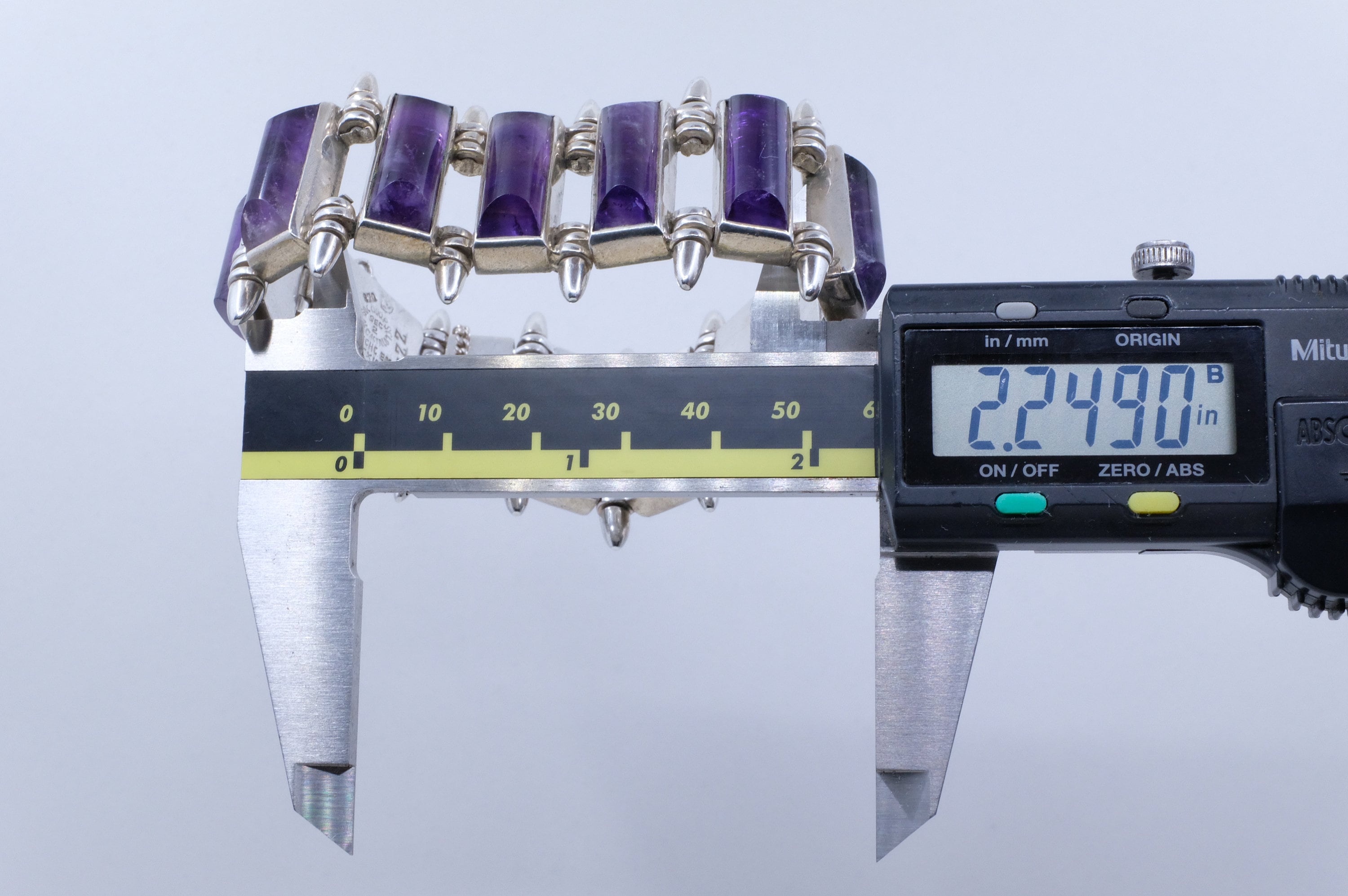
Width: [to confirm, across links]
Condition: Very good vintage, with light wear consistent with age and use. Surfaces clean, articulation tight, clasp and safety chain functional.
✦PROVENANCE AND DOCUMENTATION
Co-branded Antonio Pineda × Los Castillo pieces with this hallmark configuration are documented in the Hodosh collection (Cindy Tietze-Hodosh and Stuart Hodosh), the major private collection of mid-century Taxco silver that formed the core of the 2008–2009 Fowler Museum retrospective Silver Seduction: The Art of Mexican Modernist Antonio Pineda. A comma-link Pineda × Los Castillo bracelet from the same period and hallmark configuration is published in the literature as a book piece, and a 1962–1963 Pineda × Los Castillo cuff with the same Soc Coop Scl Sec 2 cartouche and a different ZZ-series number sold at John Moran Auctioneers from the Hodosh collection.
This bracelet sits in that documented lineage and represents one of the rarer co-marked pieces from the early 1960s cooperative-era collaboration between two of the most significant workshops of the Taxco silver renaissance.
✦From Nasado Trading Co. — a curated source for fine silver jewelry drawing from Navajo, Zuni, Tuareg, and Taxco traditions. Every piece is selected for the quality of its craft and the integrity of its making. -
Shipping & Policies
Shipping from United States
Processing time
1-2 business days
Customs and import taxes
Buyers are responsible for any customs and import taxes that may apply. I'm not responsible for delays due to customs.
Payment Options
Returns & Exchanges
Returns & exchanges accepted within 45 days
Buyers are responsible for return shipping costs. If the item is not returned in its original condition, the buyer is responsible for any loss in value.
I gladly accept returns, exchanges, and cancellations
Request a cancellation within: 0 hours of purchase
Conditions of return
Buyers are responsible for return shipping costs. If the item is not returned in its original condition, the buyer is responsible for any loss in value.
Questions about your order?
Please contact me if you have any problems with your order.
Privacy policy
As an Etsy seller, I will not personally keep, sell, or store your information for any reason, whatsoever. Etsy has its own policies which explain its own consumer data management. You can read their Privacy Policy here: https://www.etsy.com/legal/privacy. As a fellow consumer, your privacy is of the utmost importance and will be maintained at the highest level possible.
Frequently Asked Questions
Gift wrapping and packaging
I carefully gift-wrap everything all of the time at no charge. If you buy 5 rings, I may place 3 in one box and 2 in another. If you're buying two or more items and select the 'Gift' option in your cart, leave a note if you have special instructions regarding packing items in a gift box or sack before placing them in the shipping box and sending them off.
If you have any questions or special requests, feel free to contact me. 🙂Sizing details
Always check photos and descriptions for size, weight, and other measurements. These are provided to ensure a great fit.📏
Care instructions
Generally, most items can be cleaned with a lint-free cloth. Avoid prolonged contact with water as it may cause stones to loosen or leave watermarks on precious metals like silver✨
Shipping - Signature
Some items above $200 may require a signature at delivery. Contact me if a signature isn't necessary, and you’d wish to opt out.
If you want updates on your packages (Informed Delivery) as well as the option to sign for packages electronically by enrolling in USPS Electronic Signature Online/ eSOL, you may do so at the USPS website here: https://informeddelivery.usps.com/box/pages/intro/start.action
FAQs are here: https://faq.usps.com/s/article/USPS-Electronic-Signature-Online
Related Products
Hector Aguilar Scroll and Beads Bracelet
$1,000.00
Sterling Silver Link Bracelet
$100.00