Antonio Pineda Spheres
$2,500.00
-
DetailsAntonio Pineda — Spheres Bracelet
above the Sterling Silver standaard at 970 Silver, Taxco, Mexico, circa 1965–1975
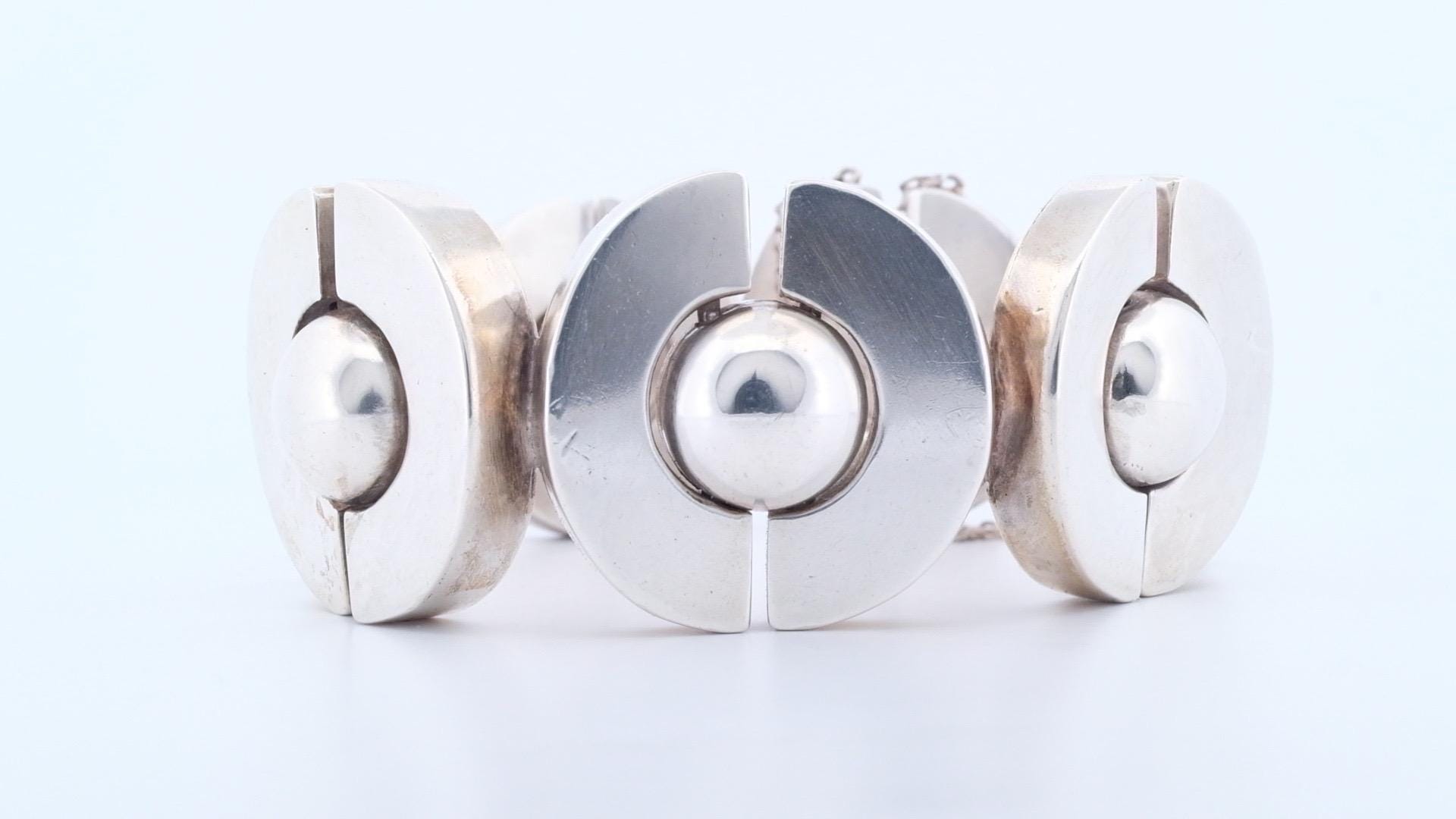
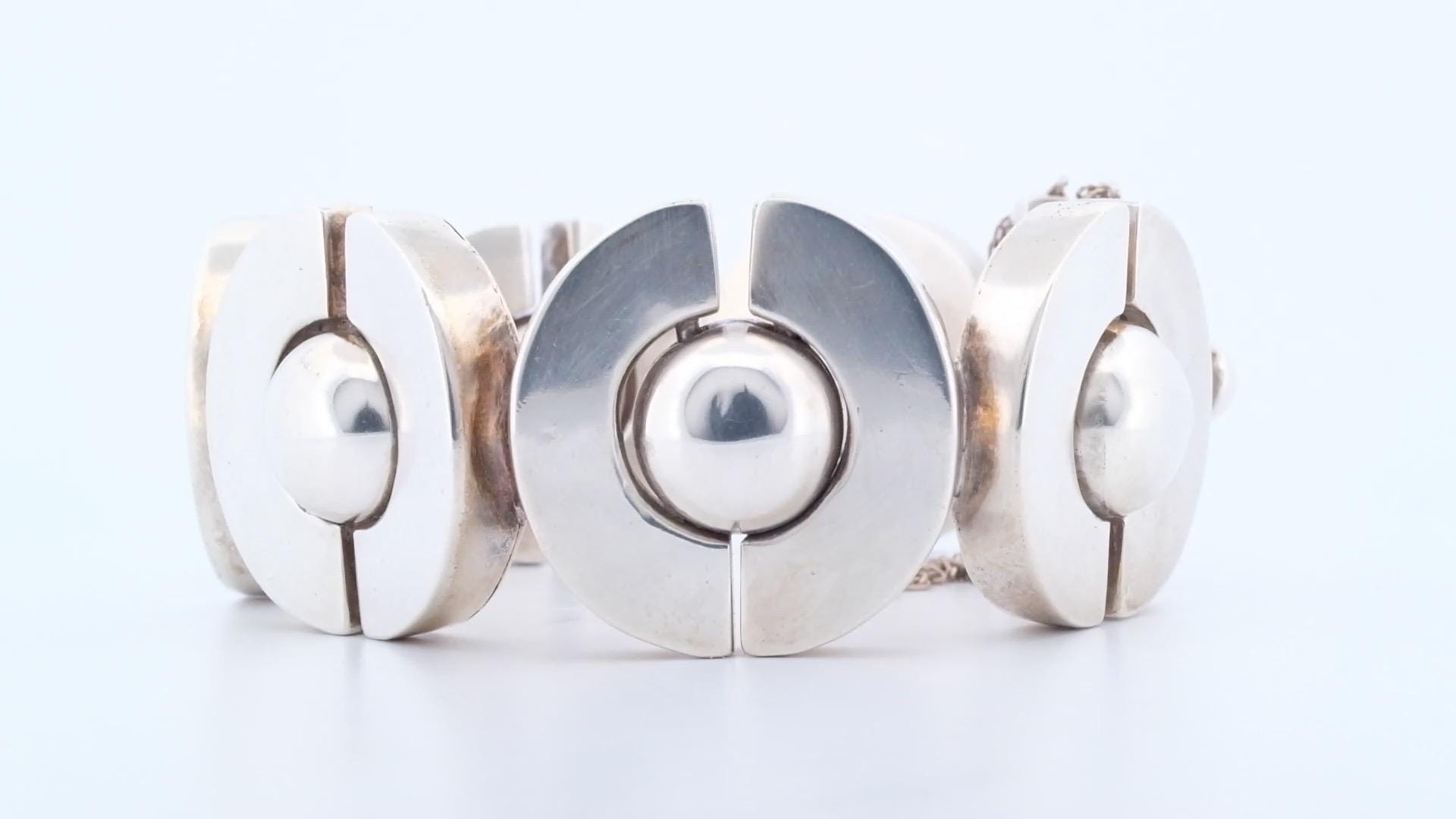
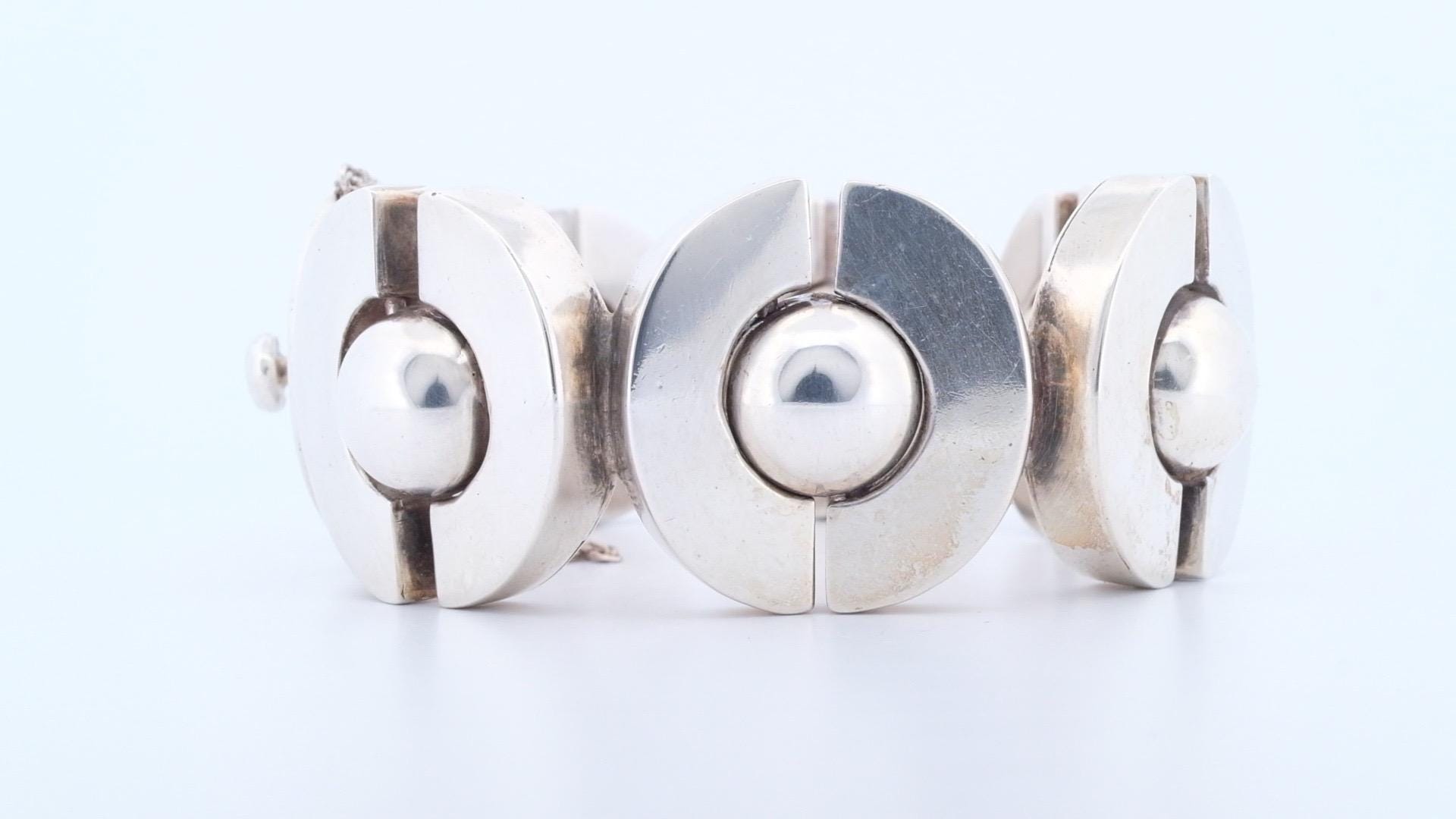
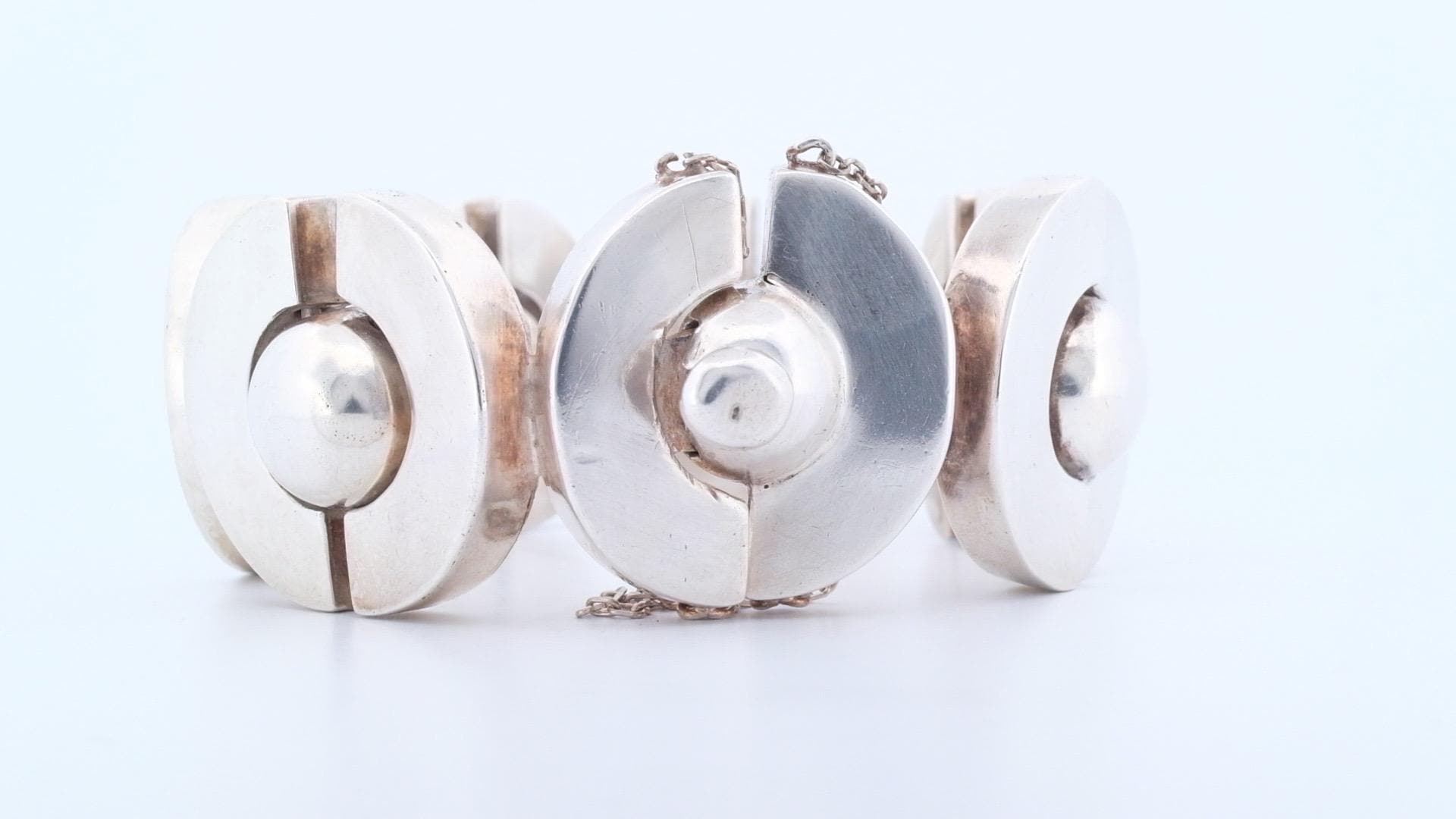
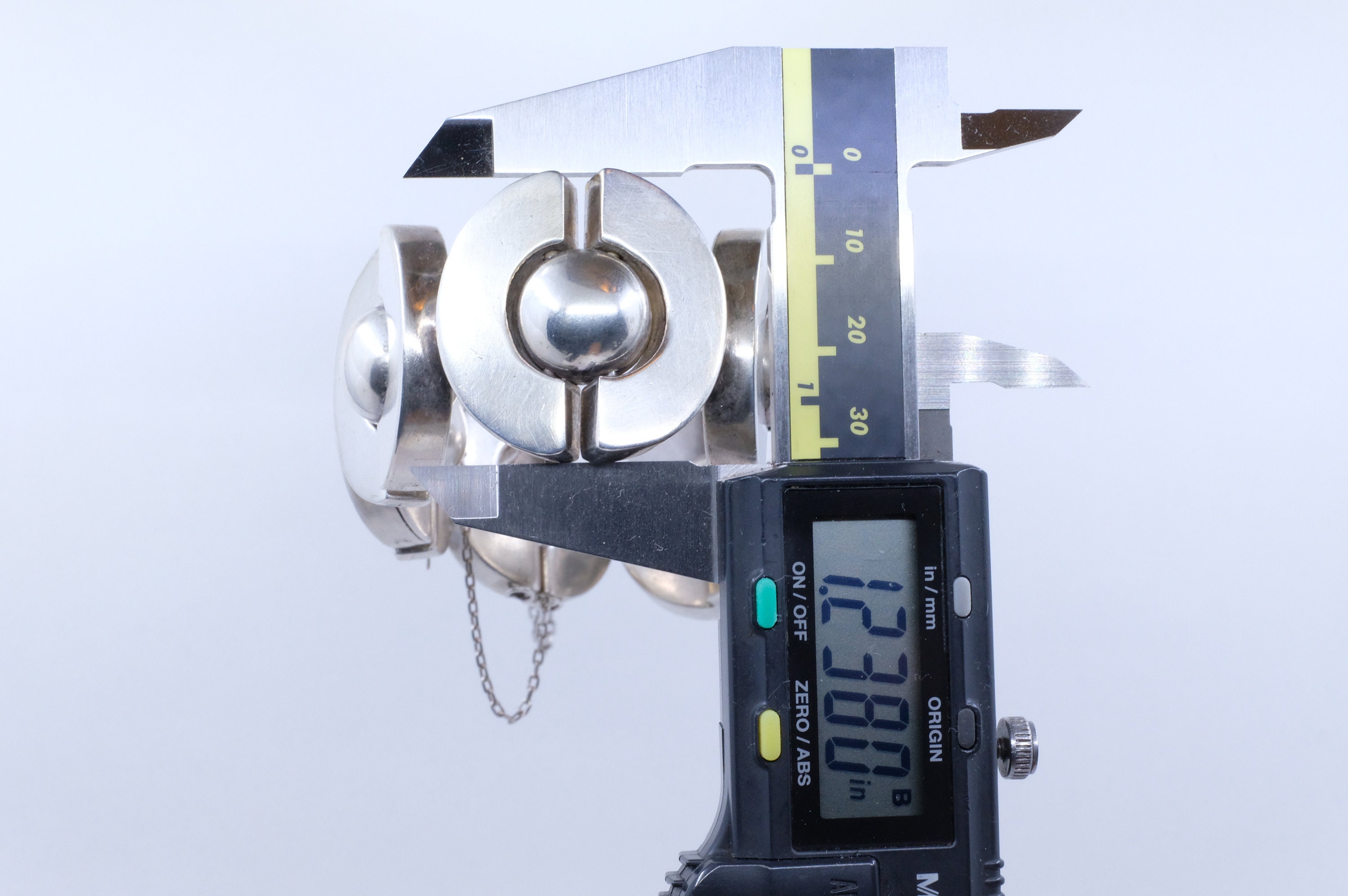
A signature design from one of the twentieth century's defining Mexican modernist silversmiths. Eight articulated disc links, each composed of two opposing C-shaped halves bracketing a captured silver hemisphere at the centerline. The design reads as a series of orbits with their planets held in place at the moment of conjunction. Negative space at the equator of every disc carries the idea: the C's are the structure, the spheres are the subject, and the rhythm of the bracelet on the wrist is the relationship between them. Articulated through hidden hinges at the back of each link, secured by a tongue-in-groove clasp with original safety chain.
The Designer
Antonio Pineda (1919–2009) is recognized in Mexico as a national treasure and internationally as one of the foremost figures of the Taxco silver renaissance. Apprenticed at age fourteen in William Spratling's Taller de las Delicias, the workshop that founded the modern Taxco school. Studied painting and sculpture in Taxco as a youth and later trained in Mexico City alongside the silversmith and Art Deco proponent Valentín Vidaurreta, an influence Pineda himself credited as central to the development of his geometric vocabulary. Opened his own workshop in 1941. By 1944 his work had been included in an exhibition at San Francisco's California Palace of the Legion of Honor, where Richard Gump purchased the entire one hundred sixty piece collection and established an exclusive American distribution arrangement that would define Pineda's reach for the following two decades. At the workshop's peak, Pineda employed nearly one hundred silversmiths.
His work entered the permanent collections of the Los Angeles County Museum of Art and the Fowler Museum at UCLA, and was the subject of the 2008–2009 Fowler retrospective Silver Seduction: The Art of Mexican Modernist Antonio Pineda, which traveled to the Museum of International Folk Art in Santa Fe in 2010–2011.
The Design
The Spheres bracelet is among the most recognized and most sought after pieces in Pineda's catalog, alongside his Thumbprint and Matchstick designs. Collectors and dealers know it variously as Saturn, Ball Bearing, Ball and Sphere, or Hubcap, all referring to the same construction. In the scholarly literature, Gobi Stromberg catalogues the design on page 52 of Silver Seduction (University of Washington Press for the Fowler Museum, 2008) under the description "Bracelet with spheres framed by opposing C's." Stuart Hodosh's Dreaming in Silver documents the same design on page 271 as "Encircled Hemispheres."
The design belongs to Pineda's pure-geometry register, the body of work that argues silver alone, without stones, can carry an entire piece on the strength of form, weight, and the relationship between volumes. The construction of each link is engineered, not decorative: the two C-halves grip the central hemisphere through internal seating, with the articulation hidden at the back of every disc, so the visual face stays pure. Pineda was widely recognized in his lifetime for hinges and clasps that disappeared into the design rather than interrupted it, and the Spheres bracelet is among the clearest examples of this discipline.
This Example
Material: 970 - above the 920 sterling silver standard
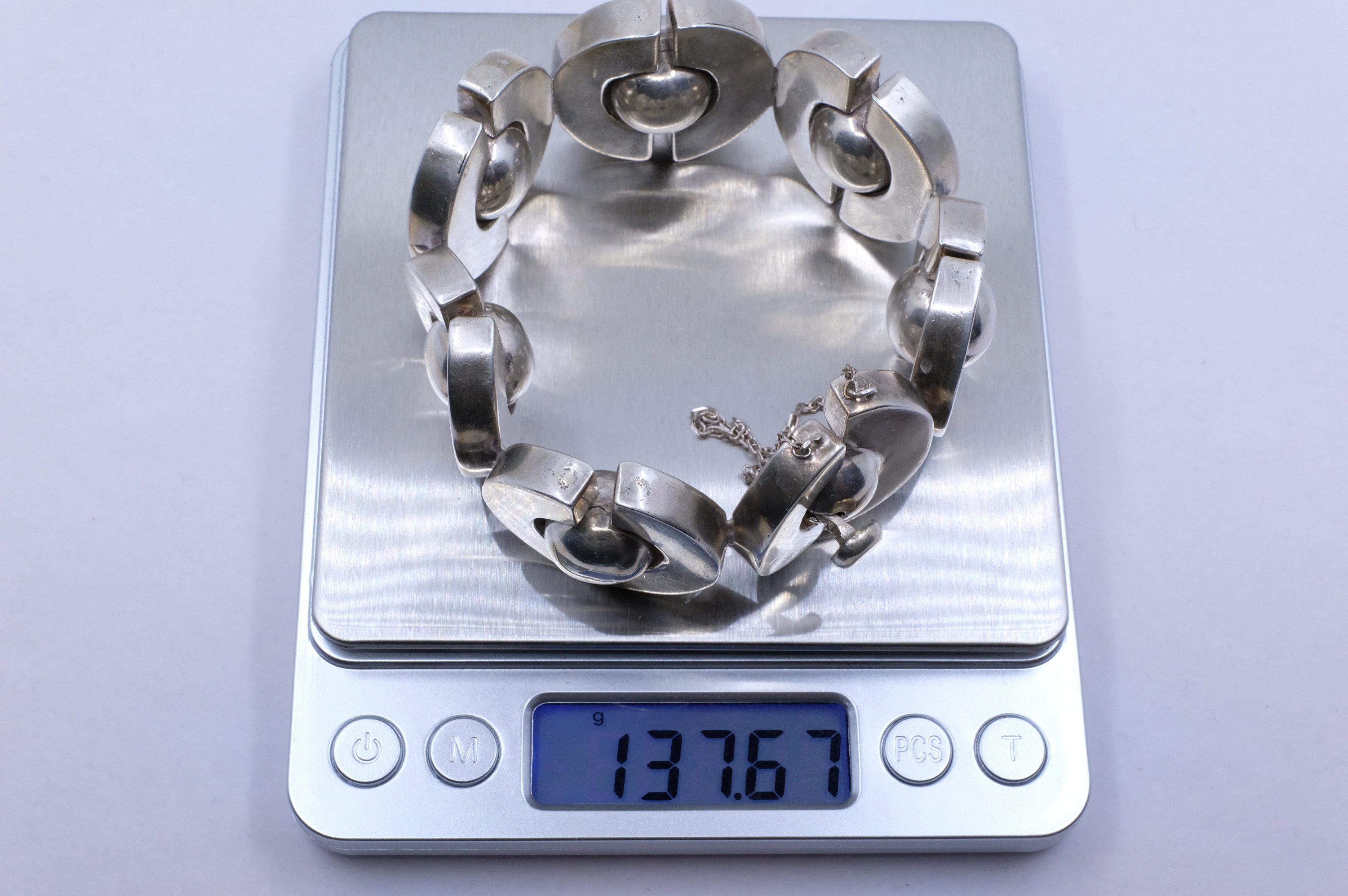
Weight: 137.67 grams
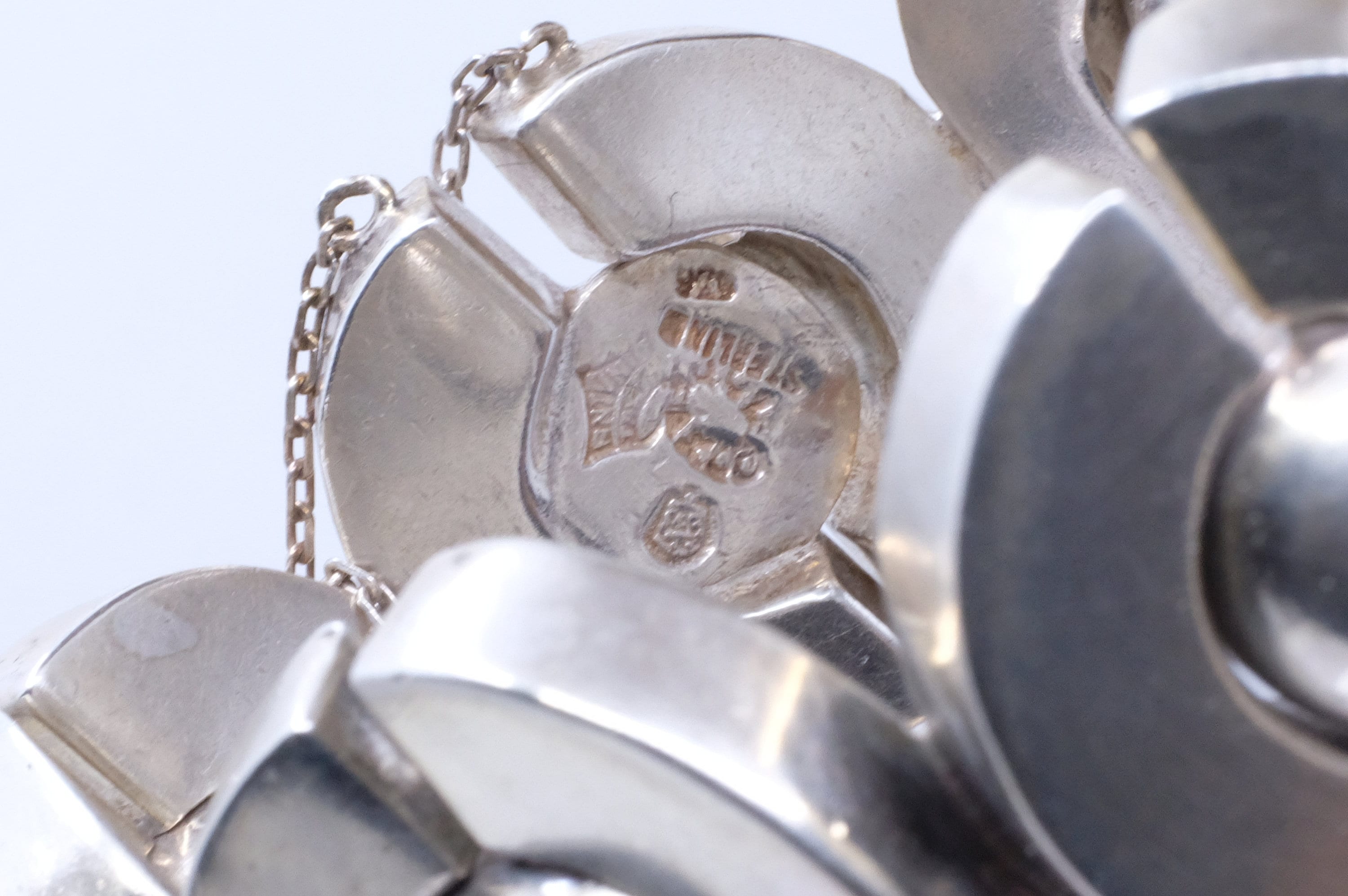
Hallmarks: Antonio crown, 925, MEXICO, eagle assay
Period: late 1960s through 1970s, dated by the 925 silver standard, which Pineda adopted in his later workshop production after working primarily in 970 and earlier in 980
Construction: eight articulated disc-and-sphere links, hidden hinges at rear, tongue-in-groove clasp with original safety chain
Condition: very good vintage, with light wear consistent with age and use; surfaces polished and clean, articulation tight, clasp and safety chain functional
The weight places this example at the upper end of the documented range for the Spheres design. Catalogued examples typically fall between 125 and 130 grams. The additional mass here corresponds to slightly thicker stock and substantial hand-finishing, both consistent with Pineda's later workshop output, where the design language remained faithful to his peak period while the silver gauge tended heavier.
Provenance and Authentication
The Antonio crown hallmark is the workshop's defining mark and the central point of authentication for any attributed Pineda piece. The crown is present and clear on this bracelet, accompanied by the Mexican government eagle assay (instituted in 1948 to identify registered silver workshops) and the 925 silver content stamp. Together these marks confirm both attribution to Pineda's workshop and the late-period dating.
The design itself is documented in two of the standard reference works on Mexican modernist silver and is represented in the Fowler Museum's permanent collection holdings. Comparable examples have been sold by major auction houses including Hindman and Toomey, and by specialist dealers including Stella Rubin, Het Westen, and Carmel Fine Silver Jewelry. The Spheres design has appeared regularly in scholarly exhibitions and trade publications since the 1970s. -
Shipping & Policies
Shipping from United States
Processing time
1-2 business days
Customs and import taxes
Buyers are responsible for any customs and import taxes that may apply. I'm not responsible for delays due to customs.
Payment Options
Returns & Exchanges
Returns & exchanges accepted within 45 days
Buyers are responsible for return shipping costs. If the item is not returned in its original condition, the buyer is responsible for any loss in value.
I gladly accept returns, exchanges, and cancellations
Request a cancellation within: 0 hours of purchase
Conditions of return
Buyers are responsible for return shipping costs. If the item is not returned in its original condition, the buyer is responsible for any loss in value.
Questions about your order?
Please contact me if you have any problems with your order.
Privacy policy
As an Etsy seller, I will not personally keep, sell, or store your information for any reason, whatsoever. Etsy has its own policies which explain its own consumer data management. You can read their Privacy Policy here: https://www.etsy.com/legal/privacy. As a fellow consumer, your privacy is of the utmost importance and will be maintained at the highest level possible.
Frequently Asked Questions
Gift wrapping and packaging
I carefully gift-wrap everything all of the time at no charge. If you buy 5 rings, I may place 3 in one box and 2 in another. If you're buying two or more items and select the 'Gift' option in your cart, leave a note if you have special instructions regarding packing items in a gift box or sack before placing them in the shipping box and sending them off.
If you have any questions or special requests, feel free to contact me. 🙂Sizing details
Always check photos and descriptions for size, weight, and other measurements. These are provided to ensure a great fit.📏
Care instructions
Generally, most items can be cleaned with a lint-free cloth. Avoid prolonged contact with water as it may cause stones to loosen or leave watermarks on precious metals like silver✨
Shipping - Signature
Some items above $200 may require a signature at delivery. Contact me if a signature isn't necessary, and you’d wish to opt out.
If you want updates on your packages (Informed Delivery) as well as the option to sign for packages electronically by enrolling in USPS Electronic Signature Online/ eSOL, you may do so at the USPS website here: https://informeddelivery.usps.com/box/pages/intro/start.action
FAQs are here: https://faq.usps.com/s/article/USPS-Electronic-Signature-Online
Related Products
Silver Etched Moroccan Bangle
$100.00
Silver Moroccan Bangle
$100.00